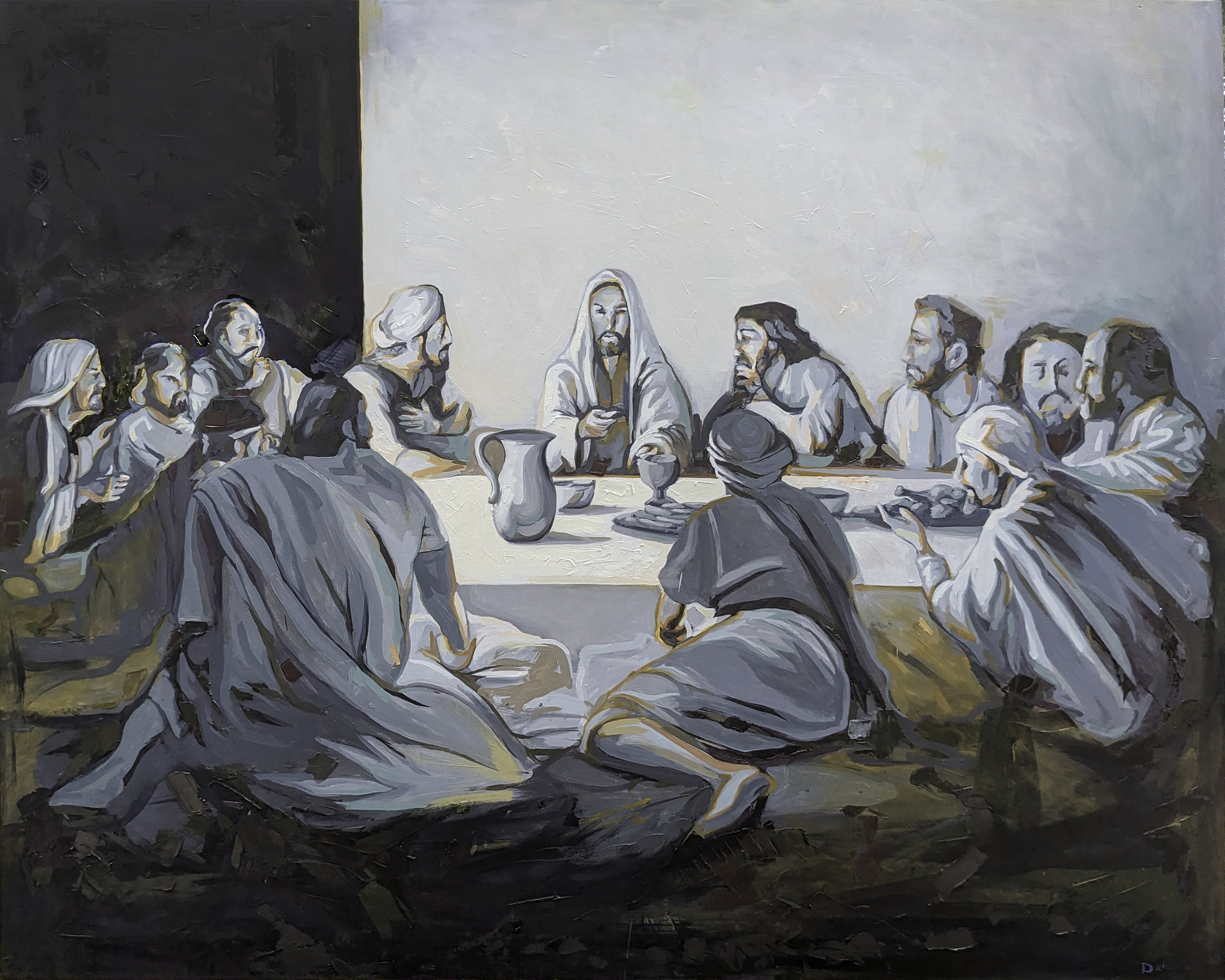
I love the representational history of biblical stories. So many great artists have taken the events of the Bible as their subject matter that it has vivified the imagination of the West through our cultural heritage. My representation of the last supper that Jesus shares with His disciples before He is crucified has been informed by that tradition a great deal, but I have changed some of the established tropes that do not fit with the Biblical narrative. In researching to correct those tropes, I have learned a lot about the Last Supper that has changed by conception of it from what it has been up to now. This process has brought me closer to the events, helped me to understand them better, and in the process has been a devotional exercise that has brought me closer to my Lord. I am including this note along with the painting so that I can document and share some of the things that I learned.
The Passover Meal as presented in the Old Testament
In Exodus 12 God instituted the Passover as a yearly feast memorializing something that He still had yet to do. God tells Moses what He is going to do for the Israelites and to the Egyptians by instituting the Passover feast. God reset Israel’s calendar to begin at Passover. He commanded that every household should take a lamb for the meal. If their household is too small, they should join with their neighbors for the feast. A 1-year-old lamb without blemish was to be chosen, either goat or sheep. Israelites should choose their lamb on the 10th of the month and keep it until the 14th, killing it at twilight.
The weight of a 1 year old lamb can vary a great deal, but averages about 100 lbs. Dressed, this makes about a 54 lb carcass, which has about 37.8 lbs of meat. That makes about 28 lbs of meat once grilled. If we estimate 1/2 lb. meat per person for the meal, this means that you could reasonably assume over 50 people present at a Passover meal, as all meat was to be consumed the night of the meal.
Unleavened bread and bitter herbs were to be included with the meal. The bitter herbs would have been the sort of foragable leafy greens growing in the area, and the unleavened bread would have been similar to other unleavened flatbreads that are still common today.
The Passover Meal as Jesus and His disciples would have eaten it
The gospels Matthew, Mark and Luke all describe how, on the day when they were to kill the Passover lamb, Jesus instructed two of his disciples to go into the city, where they would find a man carrying a pitcher of water. They were to ask him where they should eat the Passover. Since God commanded in Exodus that the lamb was supposed to be kept 4 days before slaughter, this means that Jesus and his disciples would have been joining this man and his family in eating the lamb they had been keeping at their house for 4 days. This means that there were not only 13 people at Jesus’ Passover. In Mark’s account, in 14:13 Jesus sends 2 disciples ahead to make preparations, and then in vs. 17 He arrives with “the twelve.” That makes at least 14 of Jesus’ disciples at the meal in addition to the man’s family. The fact that there are more than Jesus’ 12 disciples is verified by Mark 14:20, in which Jesus specifies, “It is one of the twelve…” who will betray him. He would not need to specify that it was “one of you…” and then “one of the twelve…” if it were only the 12 disciples who were with him. So, that makes Jesus, His twelve disciples, two other disciples, and the man and his family present at the meal.
Matthew27:55-56 leads me to believe that there were also many women at the last supper. “And many women who followed Jesus from Galilee, ministering to Him, were there looking on from afar, among whom were Mary Magdalene, Mary the mother of James and Joses, and the mother of Zebedee’s sons.” If the women came with Jesus from Galilee, where would they eat the Passover if not with Jesus. The Passover meal was a command, and as devout Jews they would have kept the tradition. In fact, if the women were ministering to Jesus, I would guess that means providing for His needs as He was occupied with teaching. That leads me to think that the two disciples that Jesus sent ahead to prepare for the meal were a couple of these women. I also think it is great that some of the disciples would have had their mothers present at the meal with them.
The meal that this large group ate would have consisted of goat or sheep cooked over fire, unleavened bread, bitter herbs, 4 cups of wine, and a singing of the Hallel songs (Psalms 113-118). According to oral tradition of the teachings of Rabbi Hillel, who lived the century before Christ, which was written down in A.D. 200 by Rabbi Judah ha-Nassi in “Pesachim” in Mishna, the bitter herbs requirement from the Torah could be fulfilled by with ḥazeret (lettuce), with chervil [tamkha], and with field eryngo [ḥarḥavina], and with endives [olashin], and with maror. These can be fresh or dried, but they cannot be pickled in water or in vinegar.[1]
I hope that these notes help give a little more information for whoever sees this painting to help them to imagine more vividly the last supper of Jesus with his disciples. Outside the bounds of the frame, I picture other tables filled with men, women and children participating in this, the first sacramental dinner that is handed down to generations of those who put their trust in Jesus. We believe He is the real sacrifice that sets us apart as the people of God so that the judgement angel will pass us over. He died for us, and now He lives!
 delongvaughn